Sharing since 2008
Sunspot Cycle 25 and What It Means for Ham Radio
We, ham radio operators, patiently wait for the 11-year sunspot cycle to rekindle the ionized layers that we rely on for long-distance propagation of our HF signals.
At each cycle, the Sun shifts from a period of relative calm - marked by few sunspots and minimal solar activity - to a peak of intense magnetic turbulence, before quieting down again.
This rhythmic pattern is known as the solar cycle, and the one we are currently living through is Solar Cycle 25.
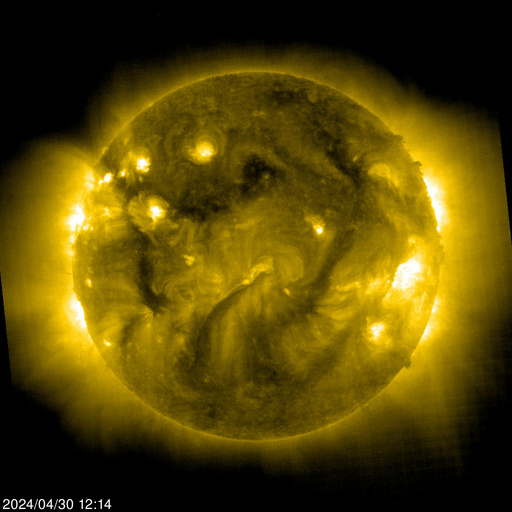
Source: https://sohowww.nascom.nasa.gov/data/realtime/eit_284/512/latest.jpg
For more info on the sun, visit: https://sohowww.nascom.nasa.gov/classroom/classroom.html
A considerable amount of information on solar data and propagation conditions is available to ham radio operators on N0NBH website. It is definitely worth a visit.
Cycle 25 had a pleasant surprise in store for us: it turned out to be much more powerful than scientists expected ... except for Dr. Scott McIntosh, who did. His research had already led him to believe that Sunspot Cycle 25 would indeed be much stronger than the previous one. He published his results for peer review as early as October 13, 2020, four years before it peaked. As it turns out, he was right!
What Is a Solar Sunspot Cycle?
A solar cycle is driven by the Sun's magnetic field, which periodically flips polarity roughly every 11 years. As the cycle progresses, the Sun's magnetic activity increases, producing more sunspots - dark, cooler regions on the solar surface caused by intense magnetic activity.
These sunspots are closely associated with solar flares, coronal mass ejections (CMEs), and other forms of space weather that can have real consequences here on Earth. Scientists have been tracking sunspot activity since 1755, and Solar Cycle 25 is, as its name suggests, the 25th such cycle on record.
The Beginning of Cycle 25
Solar Cycle 25 officially began in December 2019, following a solar minimum -- the quiet trough between cycles -- with a smoothed sunspot number of just 1.8. It succeeded Solar Cycle 24, which ran from 2008 to 2019 and was itself considered a relatively weak cycle.
The current cycle is expected to continue until approximately 2030, at which point Solar Cycle 26 will begin.
What Scientists Had Predicted
When Solar Sunspot Cycle 25 was getting underway, the Solar Cycle 25 Prediction Panel - a group of experts convened by NASA and NOAA -- issued a forecast in December 2019 that was decidedly modest.
They predicted the cycle would be similar in strength to the weak Cycle 24, with a peak smoothed sunspot number of around 115, expected to occur around July 2025.
Some scientists were even more pessimistic, suggesting the cycle could be so weak as to signal the beginning of a Maunder Minimum-like state - a prolonged period of very low solar activity similar to what occurred between 1645 and 1715.
The Reality: A Cycle That Blew Past Expectations
The Sun didn't behave as expected. From the very first years of the cycle, observations significantly exceeded predicted values. By 2022 and 2023, it was already clear that Solar Cycle 25 was tracking well above the forecast.
The cycle reached its smoothed maximum sunspot number of 160.8 in October 2024 - far exceeding the predicted peak of 115. The unsmoothed monthly sunspot count hit a high of 216 in August 2024.
Then, in January 2026, NOAA's Space Weather Prediction Center (SWPC) reported that Solar Cycle 25 had likely reached the highest daily sunspot number in over 20 years ... a value of at least 299! This remarkable figure underscored just how dramatically the cycle had outperformed expectations.
Notable Solar Events
The heightened activity of Solar Cycle 25 has produced a string of significant space weather events. Strong and even extreme solar flares have been recorded with increasing frequency. NASA's Solar Dynamics Observatory has been monitoring these events closely, with notable flares erupting throughout 2024 and 2025.
As recently as March 29-30, 2026, a strong solar flare was detected, continuing the cycle's pattern of elevated activity.
One of the most dramatic consequences of the heightened solar activity has been the widespread visibility of the aurora borealis -- the Northern Lights -- at unusually low latitudes. People across the continental United States, Europe, and other mid-latitude regions have been treated to stunning auroral displays that would normally only be visible much closer to the poles.
Effects on Earth and Technology
Solar activity at this level is not merely a spectacle. We, ham radio operators know all too well that powerful solar flares and CMEs can disrupt HF radio communications. The most powerful ones can even disrupt GPS systems, and power grids
Satellites in low Earth orbit experience increased drag during periods of high solar activity, which can affect their orbits and operational lifespans. Airlines sometimes reroute polar flights to avoid radiation exposure during major solar events.
The elevated activity of Solar Cycle 25 has kept space weather forecasters at NOAA's Space Weather Prediction Center and NASA busy monitoring and issuing alerts.
What Comes Next
Solar Cycle 25 is expected to wind down toward a new solar minimum around 2030, at which point Solar Cycle 26 will begin. Interestingly, scientists have already reported seeing early signs of the next cycle beginning to emerge. Research published (January 2026) in Nature Scientific Reports predicts that Solar Cycle 26 will peak around mid-2034.
Solar Cycle 25 turns out to be a lesson in humility about the limits of sunspot cycle prediction.
Despite decades of observation and increasingly sophisticated models, the Sun still managed to surprise the scientific community. As we move through the descending phase of this remarkable cycle, researchers will be studying its lessons carefully - both to better understand our star and to improve forecasts for the cycles to come.
The smoothed sunspot number (SSN) represents the average number of sunspots observed over a whole year.
SSN, A index, K index, solar flux, etc.?
What do the numbers mean?
I recommend this article by K9LA.
For regular information on solar activity and its effect on propagation, I recommend the
ARRL Propagation Forecast Bulletin
produced by Tad Cook, K7RA

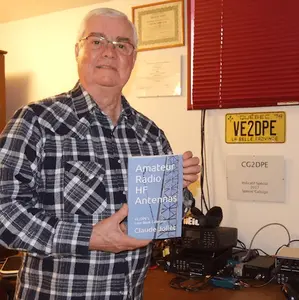
Claude Jollet, VE2DPE, has been a licensed ham since 1973 and shares decades of HF wire antenna and propagation experience at HamRadioSecrets.com. He has published many books on HF wire antennas. Readers can find him on Amazon, Youtube, QRZ and UNEQ.
73 de VE2DPE
Claude Jollet
104-30 avenue des Berges,
Notre-Dame-des-Prairies, Québec, Canada J6E 1M9
QTH Locator: FN36gb
Recent Articles


-
Ham Radio Books on HF Wire Antennas: Build or Buy, Tune, Work DX
Sep 04, 26 04:56 PM
 Stop guessing. These ham radio books show what works (and what doesn’t) for HF wire antennas, accounting for space, homemade or bought, tuners and more.
 -
Ham Radio - Amateur Radio Fascinating Secrets
May 21, 26 11:47 AM
 Ham radio or amateur radio has fascinated generations. This Web site reveals the secrets behind its enduring popularity and usefulness.
 -
World Amateur Radio Day
Apr 17, 26 01:00 AM
On April 18, 2026, amateur radio operators all over the world celebrate the 100th anniversary of the International Amateur Radio Union (IARU) which was founded in Paris, France on April 18, 1926.
Disclosure
If
you make a purchase via a link on this site, I may receive a small
commission on the transaction, at no extra cost to you. Thank you!
Disclosure
If
you make a purchase via a link on this site, I may receive a small
commission on the transaction, at no extra cost to you. Thank you!
(One word queries work best)
FOUND THIS
SITE
USEFUL?
VE2DPE
Is a member
in good standing
of

%20operator%20VE2DPE%20owner%20of%20www.HamRadioSecrets.com)
Also a proud member of an international community of solopreneurs
using SoloBuildIt!
(SBI!)
to promote my self-published eBooks
since 2005.
See my review
of this unique product for online businesses.
CQ CQ CQ
If you have a question, a comment or a topic you would like me to cover, please do not hesitate to ask here.
Have You Found This Web Site Useful?
Please contribute [ $0.99 ] - [ $3.99 ] - [ $4.99 ] - [ $5.99 ] by way of thanks.
Thank you for your contribution.
You will receive a valuable e-book in return for your generosity.
Solo Build It!
"I'm a solopreneur by design, supported by kindred minds within SBI!"Site Design & Content By Claude Jollet - VE2DPE
Certain text links and image ads on this website contain affiliate links.
I will receive a small commission - at no extra cost to you - if you make a purchase after clicking on them.
For example, as a SiteSell inc. affiliate, I earn from qualifying purchases.

The content of HamRadioSecrets.com website
is NOT generated by artificial intelligence (AI).
Scraping the contents of HamRadioSecrets.com website
for the purpose of AI (artificial intelligence) LLM (Large Language Model) training
is strictly forbidden.
Copyright© 2008-2026 Claude Jollet - HamRadioSecrets.com | All Rights Reserved