Sharing since 2008
Ham Radio Call Sign
One Of Many Codes
The ham radio call sign is the most often used ham radio code by ham radio operators when communicating with other amateur radio operators in the world.
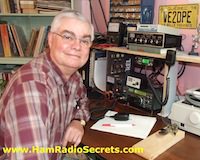 Amateur Radio Operator with Ham Radio Call Sign VE2DPE
The call sign is a code with a special purpose: it uniquely identifies each ham radio station. As you will see, there are many more ham radio codes with special purposes.
Each call sign contains
information on the location of the ham radio operator's station in the world. It identifies the country
and the region within that country where the amateur radio station is located.
All ham radio call signs begin with letters (or numbers) taken from blocks assigned to each country of the world by the ITU - International Telecommunications Union. ITU is the United Nations agency for information and communication technologies.
Each country's regulating agency will, in turn, allocate a unique call sign to each newly licensed ham radio operator.
Ham Radio Call Sign
Example
For example, my call sign VE2DPE was taken from the block of prefixes VAA-VGZ allocated to Canada by the ITU.
My call sign, as every other amateur radio call sign in the world, is composed of three parts:
- VE = the call sign prefix indicating the country as being Canada.
- 2 = the region within Canada (province of Québec).
- DPE = my own unique ham radio station identifier in Canada.
Therefore, VE2DPE is unique in the world. No two ham operators can have the same call sign.
Canada's telecommunications regulating agency - Industry Canada - can also pick amateur radio call sign prefixes from the following blocks of letter prefixes: CYA-CZZ, VAA-VGZ, VOA-VOZ, VXA-VYZ, XJA-XOZ, CFA-CKZ.
You can search for Canadian call signs here.
In The United States of America
In the United States, ham call signs are allocated by the FCC from the following blocks of prefix letters: AAA-ALZ, KAA-KZZ, NAA-NZZ, WAA-WZZ.
You can search for US call signs here.
Looking For The Owner An Old US Ham Radio Call Sign?
Old US Call Signs 1906-1997
Another ham (K8KTL) and I (K8CLI) oversee the archives at the National Voice of America Museum of Broadcasting in West Chester, Ohio. We are often searching for the owner of an old call sign that donated something to the museum. Normally QRZ is a great resource along with the FCC database, but not for all previously issued call signs back to 1912 and beyond. Call Books are our best research tool and they are all accessible but a real nuisance to locate and deal with.
So, with all this downtime we collected Amateur Radio call books from 1906 to 1997 and have them in one location. With the advent of high-speed connections, a 1 Gig download is now only 40 seconds or less. Probably not a big demand for this but it sure makes the archives research easier for us. We have no need to keep this private so if others can make use of this page, feel free to use as you wish.
73
Lee Hite
K8CLI
July 13, 2020
World Amateur Radio Prefixes
The complete updated list of international ham radio station call sign prefixes is available here.
Ham Radio Call Sign
Proper Usage
Voice Operation (i.e. SSB, FM, AM)
Amateur radio operators are required by law to identify their station - by transmitting their ham radio call sign at the beginning of each exchange of communications and at least every 30 minute.
Operators must also indicate where they are transmitting from when not operating from home base.
More Ham Radio Codes
Amateur radio operators use ham radio codes, not to be "secretive", but for the sake of brevity.
The codes are the ham radio operator's form of "short hand".
Why do we generally want to make short transmissions, preferably less than 30 seconds, certainly less than a minute? Because...
- First, it is not good etiquette to "hog" any given radio frequency.
- Second ... we never know if the conditions will hold long enough to "complete" a QSO (exchange of communications!;-)
Codes help us "squeeze" a lot of essential information in a short span of time.
"Q" Codes
"Q" codes were devised to abbreviate entire sentences (in CW) that recur often during most ham radio exchanges.
As you listen across amateur radio bands, you will often hear ham radio operators use "Q" codes.
Originally, "Q" codes were meant to shorten (condense) morse code transmissions.
Ham radio operators also use them during voice communications.
Here are a few "Q" code examples you will hear often.
- QSY - change frequency.
- QTH - station location.
- QSO - a contact (in progress or completed) between two ham radio stations.
- QSL - acknowledgement or confirmation; also means a QSL card to confirm a QSO.
See "Attachment 2" of the PDF document for list of "Q" codes.
Click here to download (PDF document 3.43 MB)
The Morse Code
Morse code (a.k.a. CW - for continuous wave signal) will often get through when voice communication is not possible due to noise and static.
Each word, or contraction thereof, is spelled out, one letter at a time. Each letter, number and punctuation mark has its specific code, a sequence of "dots" and "dashes".
For example, the following sequence of (groups of) "dots" and "dashes", inviting any ham radio station to respond to my call, will be sent out like this in CW:
_ . _ . _ _ . _ _ . . . . . . _ . . . _ _ _ _ . . . _ _ . .
Anyone listening, and able to "read" morse code, will hear "CQ de VE2DPE" (my ham radio call sign).
Click here to view the complete morse code alphabet. (Web page)
The "R-S-T" Code
The letters R-S-T ham radio codes stand for:
Readability - Signal strength - CW Tone.
Ham radio operators exchange "RST" signal evaluation reports when they communicate in CW (morse code).
For example, if the other ham station I am in contact with sends me a "RST 448" report, it means that my signal is:
- Readability = Readable with practically no difficulty.
- Signal Strength = Fair.
- Tone quality = Good D.C. note. Just a trace of ripple.
Ham radio operators, communicating by voice, will use the "RS" portion of the code to exchange signal reports.
When I get a "5 by 8" signal report, during a contact in SSB, it means that:
- My signal is perfectly readable.
- My signal is strong.
You can download a PDF document on the R-S-T reporting system here.
Ham Radio Alphabet
The A-B-C of It!
The ham radio alphabet is often essential to reliable voice communications between ham radio operators.
As a bonus, I have included the abbreviations and acronyms that you will eventually use on the air, at some time or other, in your daily practice of the amateur radio hobby.
The abbreviations make on the air communications between ham radio operators more
- efficient by reducing the amount of time required to communicate
information between amateur radio operators making contact - thus
occupying the frequency for a minimum of time - and
- effective by improving the chances of communicating essential information clearly.
The Phonetic Alphabet
The phonetic alphabet was devised to make voice communication intelligible under less than favorable conditions. In English, it is often hard to tell "s" from "f", "d" from "b" or "p", etc.
The ham radio community, by international agreement, has adopted the ICAO (see acronyms below) standard phonetic alphabet.
Thus, whenever I want to make sure that my ham radio call sign is understood correctly, I will voice it like this:
"Victor Echo 2 Delta Papa Echo" instead of spelling VE2DPE!
Click here to download
"Ethics and Operating Procedures
for the Radio Amateur"
(PDF document 3.43 MB)
The phonetic alphabet is on page 65
The Abbreviations
Amateur radio operators mainly use "Q" codes as abbreviations (see other page on ham radio codes).
When we communicate in Morse code (CW), we make heavy use of abbreviations.
Here are a few examples of some of the most common abbreviations you will hear on the ham radio bands (assuming you can "read" morse code ;-).
- ANT - antenna
- BK - break
- BTW - by the way
- CFM - confirm
- FB - fine business (good, excellent)
- GA - go ahead, good afternoon
- 73 - best regards
Click here to download
the list of most used
CW ham radio abbreviations
(PDF document 2.1 MB)
Abbreviations are on pages 33-35
The Acronyms
Any specialized field of activity has its acronyms. Ham radio is no exception.
In addition to the ham radio call sign, here are a few examples of acronyms part of the ham radio alphabet "soup":-)
- ARES - Amateur Radio Emergency Service
- APRS - Automatic Position Reporting System
- ATV - Amateur television (fast scan)
- IARU - International Amateur Radio Union
- OSCAR - Orbiting Satellite Carrying Amateur Radio
- RTTY - Radio-teletype
- SSTV - Slow-scan amateur television
- TAPR - Tucson Amateur Packet Radio
- TNC - Terminal Node Controller (Amateur Packet Radio)
I am preparing a list of acronyms that are
directly or indirectly related to ham radio.
Subscribe to this site
to be alerted as soon as I publish it.
(use the orange RSS button in left-hand column of this page)
In short, the ham radio call sign and all the other codes mentioned above allow amateur radio operators to shorten their transmissions considerably while understanding each other perfectly.
You will find helpful resources on learning how to send and receive Morse code here.

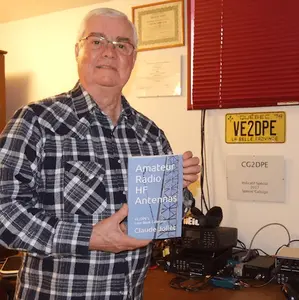
Claude Jollet, VE2DPE, has been a licensed ham since 1973 and shares decades of HF wire antenna and propagation experience at HamRadioSecrets.com. He has published many books on HF wire antennas. Readers can find him on Amazon, Youtube, QRZ and UNEQ.
73 de VE2DPE
Claude Jollet
104-30 avenue des Berges,
Notre-Dame-des-Prairies, Québec, Canada J6E 1M9
QTH Locator: FN36gb
Recent Articles


-
Ham Radio Books on HF Wire Antennas: Build or Buy, Tune, Work DX
Sep 04, 26 04:56 PM
 Stop guessing. These ham radio books show what works (and what doesn’t) for HF wire antennas, accounting for space, homemade or bought, tuners and more.
 -
Ham Radio - Amateur Radio Fascinating Secrets
May 21, 26 11:47 AM
 Ham radio or amateur radio has fascinated generations. This Web site reveals the secrets behind its enduring popularity and usefulness.
 -
World Amateur Radio Day
Apr 17, 26 01:00 AM
On April 18, 2026, amateur radio operators all over the world celebrate the 100th anniversary of the International Amateur Radio Union (IARU) which was founded in Paris, France on April 18, 1926.
Disclosure
If
you make a purchase via a link on this site, I may receive a small
commission on the transaction, at no extra cost to you. Thank you!
Disclosure
If
you make a purchase via a link on this site, I may receive a small
commission on the transaction, at no extra cost to you. Thank you!
(One word queries work best)
FOUND THIS
SITE
USEFUL?
VE2DPE
Is a member
in good standing
of

%20operator%20VE2DPE%20owner%20of%20www.HamRadioSecrets.com)
Also a proud member of an international community of solopreneurs
using SoloBuildIt!
(SBI!)
to promote my self-published eBooks
since 2005.
See my review
of this unique product for online businesses.
CQ CQ CQ
If you have a question, a comment or a topic you would like me to cover, please do not hesitate to ask here.
Have You Found This Web Site Useful?
Please contribute [ $0.99 ] - [ $3.99 ] - [ $4.99 ] - [ $5.99 ] by way of thanks.
Thank you for your contribution.
You will receive a valuable e-book in return for your generosity.
Solo Build It!
"I'm a solopreneur by design, supported by kindred minds within SBI!"Site Design & Content By Claude Jollet - VE2DPE
Certain text links and image ads on this website contain affiliate links.
I will receive a small commission - at no extra cost to you - if you make a purchase after clicking on them.
For example, as a SiteSell inc. affiliate, I earn from qualifying purchases.

The content of HamRadioSecrets.com website
is NOT generated by artificial intelligence (AI).
Scraping the contents of HamRadioSecrets.com website
for the purpose of AI (artificial intelligence) LLM (Large Language Model) training
is strictly forbidden.
Copyright© 2008-2026 Claude Jollet - HamRadioSecrets.com | All Rights Reserved