Ham Radio Operator
VE2DPE
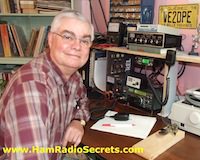 Ham radio operator VE2DPE
I became a ham radio operator through shortwave listening and my love of electronics.
I inherited both passions from my uncle. I had often observed him (in total awe) repairing tube-type radios and TVs in his basement workshop.
I fell head over heels in love with electronics and shortwave radios when, one day, he fired up a shortwave radio that he had just repaired. I was about six years old then!
I'll never forget that day.
My Call Sign
I took a ham radio training course from the Montreal Amateur Radio Club in 1973. The instructors and club members were tremendously helpful.
Soon after after passing the exams, and getting my call sign, I applied to get a license plate with my call sign to proudly put on my car!
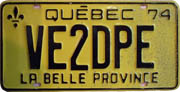
As far back as I can recall, I have always been fascinated by shortwave radios. I used to read (devour) the electronic articles in Popular Mechanics magazine back in '58.
One day, I built my first transmitter by modifying an FM receiver with the help of instructions and schematics in that magazine.
My sister would listen to my transmissions on a portable AM/FM radio down the street. "Operating" from my upstairs bedroom, I could see her jump up and down when I "transmitted" loving words to her over the air waves!
I was hooked!
My First
Ham Radio Receiver
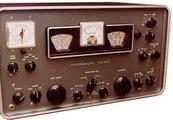 Source: www.eham.net
I bought my first serious receiver in 1972. It was a used Hammerlund HQ-180. I would shut the lights in my room ("shack-to-be") in the evening and watch the luminous dials, and the S-meter swing, as I listened to ham radio operators from exotic far away countries. Man, what a thrill that was!
I knew nothing about antennas then. (I had strung a random length wire out the window and about 3 meters above ground to a post some 10 meters away).
I practiced copying CW on that receiver for hours. Every day, I would test my ability to copy ... while my wife would test her ability to cope!
We had only been married for two years then! We are still together after 40 years. She was tough ... and still is ;-)
My First
Ham Radio Operator Shack
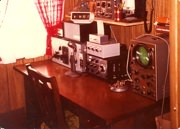 My 1974 ham shack
I obtained my first ham radio operator license as VE2DPE in late 1973. However, I finally assembled my first true radio operating room in 1974.
Here is what my first ham shack looked like.
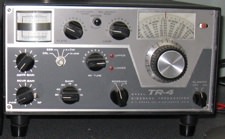 Drake TR-4 XCVR
- A Drake TR-4 Hybrid Transceiver. The vfo and local oscillator were transistorized while the rest ran on vacuum tubes ("valves" outside North-America).
- A homemade audio processing unit for the microphone.
- A homemade antenna tuner (transmatch) with a roller inductor and two heavy-duty variable capacitors salvaged from old army "signal corp" surplus equipment.
- An old tube-type signal generator (on the shelf) that I used with the old oscilloscope when I was experimenting with new circuits, or playing at fine-tuning my TR-4.
- A old tube-type VTVM.
- And, of course, a classic "brass-pounder" (cw key) set on a very heavy homemade metal base. I don't know many hams who can pound a clean 20 WPM on a monster like that any more (sigh)!
Man! Just describing it brings back warm memories!
My Ham Radio Shack Today
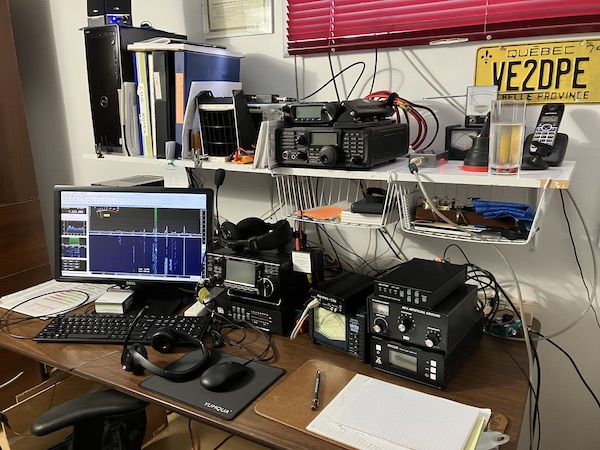 Ham radio operator VE2DPE ham radio shack
On the table top are the main station equipment:
- An ICOM 7300 100w SDR transceiver coupled with a LDG 600 Pro tuner connected to an HF all band inverted 'L';
To its right...
- A HERMES Lite 2 (HL2) QRP SDR transceiver operated in conjunction with PowerSDR software on the Windows PC;
- A CN-901 SWR/PWR meter to monitor power fed from the HL2 to the Xiegu XPA 125B power amplifier in order to prevent power amplifier harmonic distortion;
- A RBI-1 Relay Buffer Interface by HamGadgets.com to protect the HL2's delicate amplifier keying circuit from the amplifier's relays;
- A Xiegu XPA 125B "100 watt" amplifier (max 70-80 watts without harmonic distortion) which can be bypassed when QRP operation is desired;
- Coupled with a mAT 125E automatic tuner connected to an HF all band inverted 'L'.
- A MFJ-931 Artificial ground to experiment with oddball outdoor antennas! :)
Hidden behind the PC screen...
- An Astron RS-50M 13.8 VDC 50 watt linear power supply for the IC-7300 and the Xiegu XPA 125B
- A Daiwa PS-304 30A (max) variable DC switching power supply for the HL2 and sundry accessories.
On the shelf above are:
- A backup ICOM IC-7200
- To its right - An antenna interface module for a Wellbrook ALA1530 Active 50kHz-30MHz 1m dia. receiving Loop installed outdoors. The interface prodides 12 VDC power to the loop and it feeds received signals to an AirSpy/SpyVerter SDR receiver combo (above and to the immediate left of the Yaesu FT0891) - thence, by USB cable, to the SDRConsole software on the PC. The Wellbrook loop provides outstanding noise-free HF reception.
- A Yaesu FT-891 HF mobile transceiver (for camping outings in our 13 ft travel trailer)
The ICOM IC-7300 xcvr has become "second fiddle" to the HL2. I am a huge fan of the "Pure Signal" technology in the HL2. A true ham radio operator 's dream machine!
I have more to say about SDR here on this site.
Stay tuned,
73 de VE2DPE - Claude

|
P.S. My new hobby - an extension of the amateur radio hobby - is to promote ham radio to thousands of unique visitors each month with this Web site. Such outstanding results became possible when I discovered how to become an "infopreneur" with a unique "solopreneur business builder": Solo Build It! |
See my review of SBI! for a glimpse at what I think about it.
Can't find what you want?
Ask for it here!
73 de VE2DPE
Claude Jollet
7, Rue de la Rive, Notre-Dame-des-Prairies, Québec, Canada J6E 1M9
QTH Locator: FN36gb
Recent Articles


-
Ham Radio - Amateur Radio Fascinating Secrets
Apr 21, 24 11:06 AM
 Ham radio or amateur radio has fascinated generations. This Web site reveals the secrets behind its enduring popularity and usefulness.
 -
World Amateur Radio Day (WARD)
Apr 17, 24 08:00 PM
April 18, 2024 is World Amateur Radio Day (WARD). Let's all get on the air and make contacts to celebrate this event in style! -
The Ham Radio Infopreneur In You
Apr 01, 24 11:17 AM
Believe it or not, there is an infopreneur (online entrepreneur) in many of us! Often, all you need to make it bloom is proper guidance. You can get it here.


Disclosure
If
you make a purchase via a link on this site, I may receive a small
commission on the transaction, at no extra cost to you. Thank you!
Disclosure
If
you make a purchase via a link on this site, I may receive a small
commission on the transaction, at no extra cost to you. Thank you!
(One word queries work best)
About Me
Section
Contents
About Me
Contact Me
About This Site
Ham Infopreneur
Web Design
Building Sites
Testimonials
Solo Build It! Review
FOUND THIS
SITE
USEFUL?
VE2DPE
Is a member
in good standing
of




%20operator%20VE2DPE%20owner%20of%20www.HamRadioSecrets.com)
Also a proud member of an international community of solopreneurs
using SoloBuildIt!
(SBI!)
to promote my self-published eBooks
since 2005.
See my review
of this unique product for online businesses.
CQ CQ CQ
If you have a question, a comment or a topic you would like me to cover, please do not hesitate to ask here.
Have You Found This Web Site Useful?
Please contribute [ $0.99 ] - [ $3.99 ] - [ $4.99 ] - [ $5.99 ] by way of thanks.
Thank you for your contribution.
You will receive a valuable e-book in return for your generosity.
Solo Build It!
"I'm a solopreneur by design, supported by kindred minds within SBI!"Site Design & Content By Claude Jollet - VE2DPE
Certain text links and image ads on this website contain affiliate links.
I will receive a small commission - at no extra cost to you - if you make a purchase after clicking on them.
For example, as a SiteSell inc. affiliate, I earn from qualifying purchases.

Copyright© 2008-2024 Claude Jollet - HamRadioSecrets.com | All Rights Reserved