Ham Radio Antennas
All ham radio antennas involve compromises. Here is how to choose the set of compromises that will best fit your particular situation.
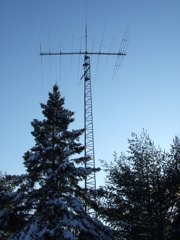
Virtually all ham radio operators use the same antenna for both receiving and transmitting on a given amateur radio band. That is a compromise in itself.
The high performance yagi type antenna in the picture is one of the best set of compromises available for a multi-band operation on HF.
The greater the number of frequency bands you want to work with the same antenna system, the greater the number of compromises you will have to live with. But few of us have the space or the money to have individual antennas for each band!
Ham Radio Antennas
on HF
A Setup To Avoid!
Here is a common example of the worst possible setup, all too often encountered on the HF bands.
Avoid being . . .
The amateur radio operator calling "CQ"
while feeding maximum legal power
into a multi-band trap dipole
or, worse, a multi-band trap vertical!!!
Such an operator will often not "hear" the hams answering his calls!
Why?
Because of the poor receiving efficiency of such ham antennas even if, when installed properly, they appear to be relatively effective radiators!
Under full legal transmitting power, the signal can be detected so far away that the antenna cannot detect the signal of the DX (far distant) station responding to the call!
The Ideal
Ham Antenna Setup for HF
There are ways to avoid unbalanced HF operating conditions such as described above.
- Reduce transmitting power to correspond with the receiving capabilities of the amateur radio antenna you are using.
- Use a separate, high performance receiving antenna such as a low noise small HF active loop.
- Or, use a beam type directional antenna, on your ham radio tower, for both transmitting and receiving (as in the picture at the beginning).
You can even design your own "dream antenna" using a antenna design program and build your next homemade ham radio antenna.
Ham Radio Antenna
Selection Tips
Every ham radio antenna is full of inevitable compromises. Some antennas have more than others as we will see here.
When choosing or building a ham antenna (amateur radio antenna), the most common compromises you have to make will fall in the following categories:
- Cost of a commercially made antenna or cost of parts if homemade.
- Available space (both horizontal and vertical).
- Durability.
- Performance (of course!).
- City bylaws (increasingly ... sigh!).
The above are by no means the only types of compromises. But dealing (playing) with them constitute the kind of challenge I like to take up.
In Search Of
The "Perfect" Antenna
If perfect antennas were possible I would make them and become a millionaire!
The bad news is that the perfect antenna does not exist, even in theory! The theoretically perfect antenna can never be built ... because theory itself is not perfect!
However, the good news is that experimenting with homemade antennas is one of the most accessible and enjoyable aspects of amateur radio. With patience and determination you will sometimes come close to the "perfect" solution to your needs... such as this multiband HF antenna!
Home-Brewed
Ham Radio Antenna
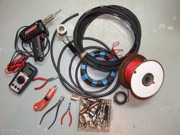 Antenna parts and tools
There is nothing more satisfying than building a few prototypes and getting better results with (almost) each new one.
Trust me. I know because experimenting with homemade antennas is the part of ham radio that I love the most.
The parts I love best are...
- Studying (learning) basic antenna theory.
- Researching and studying experiments made by other hams.
- Designing my own ham radio wire antenna with its own compromises.
- Erecting and testing it on the air.
...then starting all over again!
I especially love playing with wire antennas and stealth antennas, such as attic antennas.
In fact, when you hear me on the bands its likely because I am testing the performance of my latest "baby".
For example, take a look at my "VE2DPE 160M Special"!
Don't have the horizontal space for a 160 meter ham radio antenna? Then try your hand at building a much smaller . . .
- ham radio dipole for 10 meters - or even a
- folded dipole for 6 meters and, why not try this
- portable NVIS antenna for 40 meters!
These are easy and fun to built and use on the air!
If you do not have the real estate to put up a "classic" half-wave horizontal dipole, don't despair! Here are some space-saving configurations of the ham radio HF antenna that might do the trick!
For even more space saving ideas for HF antennas, see this page on short ham antennas and this one on a "loaded" short dipole.
For those of you who are looking for a seperate receive antenna, which is not susceptible to interference (EMI or RFI), I suggest you have a look at the small active loop.
Read What Our Visitors Have Shared About Their Antennas
Click the links below to read the heartfelt accounts that other visitors of this page have shared with the world about their antennas.
Linear-Loaded Multi-Band Fan Dipole 
Good day Claude. I am in Cape Town, South Africa and I have come across your interesting and informative subject of "Short Ham Antennas for HF With Linear …
My Homemade VHF/UHF Dual Band Vertical Dipole Antenna
I enjoy building antennas. A fellow Ham recommended that I try building a 2 meter / 70 centimeter vertical dipole antenna. I read the article he was referring …
Home made magnetic loop antenna
I have seen many adds for commercial magnetic loop antennas 300 dollars and up in price. I didn't want to spend that much money on an antenna that might …
Folded Dipole Homemade Ham Radio Antenna
NOTE: important corrections have been made on June 16, 2019 to the following text.
I have just put up a homemade ham radio antenna. It's a folded …
HF Antenna Wire 
What is better to use for antenna wire: aluminum ground wire, old coax, or stranded #12 or #10 copper?
I have used all successfully, but I wonder about …
HF Antenna Advice Requested
I need some advice on what kind of HF antenna to purchase.
This is where I want to install my first HF all band antenna. Can someone recommend a good …
My Homemade 40-Meter NVIS Linear-Loaded Dipole for POTA Not rated yet
Hi Claude,
I want to thank you for the design of the NVIS portable antenna.
I built it to the dimensions given in your article (see reference link …
My Homemade Multiband HF Fan Dipole Antenna Not rated yet
My stacked dipole worked great on 10, 15 & 20 meters but when I tried adding a 40-meter element, it was too big. (See reference at the end of this article) …
Build a Vertical Dipole Antenna - My Homemade HF Tri-Bander Not rated yet
This article describes how to build a vertical dipole antenna for 20, 15 and 10 meters. It is only 8.3 feet tall and sports three active concentric ring …
How to Improve an Attic SWL Antenna Not rated yet
I am looking to improve the performance of an attic SWL antenna that I have been using for more than 10 years.
I have a Yaesu FRG-8800. I have had the …
Next ...Tips on choosing appropriate ham radio antennas.
73 de VE2DPE
Claude Jollet
104-30 avenue des Berges,
Notre-Dame-des-Prairies, Québec, Canada J6E 1M9
QTH Locator: FN36gb
Recent Articles


-
World Amateur Radio Day
Apr 18, 25 12:00 AM
On April 18, 2025, amateur radio operators all over the world celebrate the 100th anniversary of the International Amateur Radio Union (IARU) which was founded in Paris, France on April 18, 1925. -
The Off-Center-Fed Dipole (OCFD)
Mar 18, 25 10:57 AM
 The off-center-fed dipole is a versatile multiband HF antenna when properly fed. Understanding how it works can pay dividends. Here is what you need to know.
 -
Ham Radio - Amateur Radio Fascinating Secrets
Mar 18, 25 10:44 AM
 Ham radio or amateur radio has fascinated generations. This Web site reveals the secrets behind its enduring popularity and usefulness.
Disclosure
If
you make a purchase via a link on this site, I may receive a small
commission on the transaction, at no extra cost to you. Thank you!
Disclosure
If
you make a purchase via a link on this site, I may receive a small
commission on the transaction, at no extra cost to you. Thank you!
(One word queries work best)
HF Antennas
Section
Contents
VHF/UHF Antennas
FOUND THIS
SITE
USEFUL?
VE2DPE
Is a member
in good standing
of



%20multiband%20yagi%20antenna.)
%20operator%20VE2DPE%20owner%20of%20www.HamRadioSecrets.com)
Also a proud member of an international community of solopreneurs
using SoloBuildIt!
(SBI!)
to promote my self-published eBooks
since 2005.
See my review
of this unique product for online businesses.
CQ CQ CQ
If you have a question, a comment or a topic you would like me to cover, please do not hesitate to ask here.
Have You Found This Web Site Useful?
Please contribute [ $0.99 ] - [ $3.99 ] - [ $4.99 ] - [ $5.99 ] by way of thanks.
Thank you for your contribution.
You will receive a valuable e-book in return for your generosity.
Solo Build It!
"I'm a solopreneur by design, supported by kindred minds within SBI!"Site Design & Content By Claude Jollet - VE2DPE
Certain text links and image ads on this website contain affiliate links.
I will receive a small commission - at no extra cost to you - if you make a purchase after clicking on them.
For example, as a SiteSell inc. affiliate, I earn from qualifying purchases.

Copyright© 2008-2025 Claude Jollet - HamRadioSecrets.com | All Rights Reserved