Ham Radio Transceivers
Selection Tips
There are so many ham radio transceivers (XCVRS) to choose from that the beginning ham radio operator (that I once was ;-) can easily make the wrong choice ... out of lack of experience.
Really, the best way to avoid making costly mistakes is to get acquainted with as many different transceivers as you can ... before buying one!
Getting Acquainted With
Ham Radio Transceivers
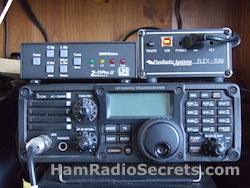
How can you familiarize yourself with various transceivers ... without actually owning one?
- By trying the club's station transceiver(s), if you belong to a ham radio club.
- By trying the rig of other ham radio operators, as a guest at their ham radio station.
But, you will soon become anxious to own and operate your own.
I recommend that you buy a used ham radio transceiver to start with. This way, you will...
- acquire a taste for some of the features it has and that you will want your new transceiver to have.
- develop a desire for the features it should have
Your First HF XCVR
Your first used HF ham radio transceiver should preferably have a tube-type final amplifier section! Why? Because they are somewhat more forgiving than solid state final amplifiers.
Face it. We all make mistakes. You will too. You are bound to try to load into thin air one day ... or forget to check if your antenna is still there before tuning up.
With solid state, the finals may be toasted by the time you say "Oops!". Tube "finals" may let you make mistakes and still continue to amplify ... even if somewhat less efficiently after each careless treatment!
Judging from the requests for information I get, it looks like the most popular manufacturers of ham radio transceivers are...
Kenwood - Icom - Yeasu - Elecraft - Ten-Tec -Alinco - Xiegu
All these manufacturers build reliable transceivers (XCVRS) for use on the ham radio bands. A few have even begun to offer "hybrid" models that incorporate some SDR (Software Defined Radio) techniques. More on SDR below.
The "All-In-One" Trap
Personally, I avoid "all-in-one" ham radio transceivers. If your transceiver covers...
- all HF amateur radio frequency bands
- and 6 meters
- and 2 meters
- and 70 cm
- and...
... you are relying on only one rig to cover all your operating needs! You're "dead in the water" if it fails and you have to part with it for days (weeks) until it gets repaired! :-(
Avoiding Disappointment
Read as many reviews from reputable, competent and manufacturer-independent sources as you can. I rely on reviews published by the ARRL to compare ham radio transceivers.
For equipment reviews, and to stay on top of new emerging technologies, I buy the CD-ROM of ARRL Periodicals as soon as it becomes available, every year. It's fully searchable and, of course, a very compact library of "fresh" and reliable information. Very handy.
The SDR Revolution
The introduction of SDR in transceivers is as significant as the transistor was to tube type equipment back in the 70's. Revolutionary!
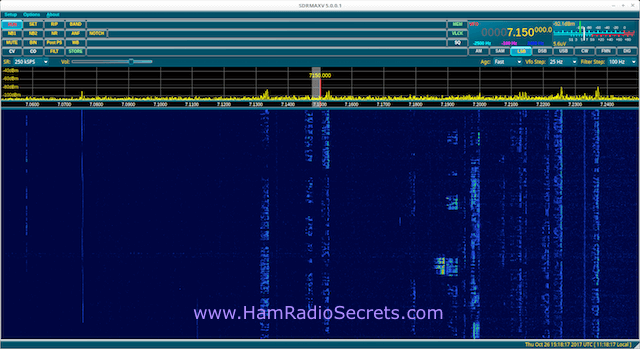
Please be aware that SDR is rapidly invading the ham radio market. FlexRadio Systems® already offers four models of SDR amateur radio transceivers.
The small box in the upper right corner of the image (at the beginning of this page above) is a FlexRadio Systems® FLEX-1500 HF 5 Watt (QRP) SDR XCVR.
The FlexRadio Systems® software is Widows-based but a Linux and Mac OS X versions are said to be "in the works".
When the linux-based SDR software becomes robust, with enough features to satisfy the more demanding of ham radio operators, then the demand for SDR transceivers will explode!
This will mean good news and bad news.
The good news will be very affordable feature-loaded transceivers using free linux-based SDR software driving minimal hardware (final amplifier and antenna interfacing circuitry).
The bad news is ... if you spend a few thousand dollars on a new solid-state transceiver today, chances are that SDR will soon make them antiques, like tube-type transceivers became when solid-state XCVRS took over the market.
Keep this in mind when you are shopping for a transceiver.
The New Breed of
Ham Radio Transceivers
Ham radios used to be relatively easy to select. As far back as I can remember, there had always been around five main manufacturers.
Not any more! Things are changing dramatically, and for the better.
Now, there are more choices than ever.
The small box in the top right corner of the photo is a fine example of what we can now choose to use on the air.
More on that type of transceiver in a moment.
Traditionally, most hams would select a transceiver for its...
- technical characteristics,
- favorable recommendations from other hams,
- and, let's admit it openly, "sexy looks"
(lots of knobs & dials ;-)
Ham Radio XCVRS
Going "Soft"
Today, there are still around five or six major manufacturers of "hardware" (not counting kit manufacturers).
But, the choices have at least doubled now, with the advent of
"Software Defined Radios" (SDR).
Some components of amateur radio equipment have not changed (yet). We all still need (for now, at least)...
- antenna hardware,
- antenna support(s),
- transmission line(s),
- hardware and firmware receive interface circuitry,
- hardware transmit amplifier circuitry.
Beyond that ... everything has now gone soft.
SDR can now replace the circuitry that used to handle the signals...
- received from the antenna or
- generated (voice, CW, RTTY, packet...) for transmission
...with software running on inexpensive PCs, and do a much better job than the hardware/firmware of conventional ham transceivers and receivers.
A Strong New Wave
"Software defined radio" (SDR) technology has improved the performance of amateur radios considerably.
Some of the high performance "military grade" signal processing capabilities used to be inaccessible to amateur radio operators. Only a rare few could afford such equipment.
Not any more. Software Defined Radio (SDR) is changing that.
SDR is revolutionizing amateur radios
as deeply as the transistor did in the early 70's!
SDR is modifying the amateur radio landscape in a hurry. New players are coming on line ... and old ones are recycling!
The "sexy looks" of yesterday's ham rigs are fast losing ground to the "configurable sexy display panels" of SDR!
New Riders On The Wave
The amateur radio manufacturers have noticed. SDR is the way of the future, now! They are already feverishly making plans to adapt their offerings to this new irreversible trend.
Just watch. I predict that yesterday's major players will soon be offering SDR-driven versions of their ham receivers and ham transceivers.
Right now, a lot of the pioneering SDR software is freely available.
Experiment with it.
Get familiar with its exciting new features.
The experience you'll gain, by "playing" with what's being developed today, will become invaluable when the time comes for you to buy your first Ham SDR of the 21st century!
Click Here To Download
A list of the major manufacturers
of ham radios.
(PDF document 23KB)
Mobile Ham Radio Transceivers
Safety Tips!
Basic mobile ham radio safety considerations have not changed much since my early days as a ham radio operator.
However, technology has invaded much of our mobile environment. This has added some new safety considerations to an already long list.
Today, an additional concern comes from the legal department.
Does the law allow us to use our mobile rig while driving? Not everywhere anymore. Not always ... as always!
Needless to say that, in all cases, it's in the best interest of all concerned that we abide by the law and basic safety rules - not to mention basic courtesy!Safe Power Levels
Safety first!
Your life and that of others depend on your responsible behavior.
The increasing use of dedicated micro-computers in cars to control critical functions such as
- ignition, fuel mixture and emissions ...
- ABS braking systems!
- etc.
...makes it imperative that you use as little output power as required to maintain contact when operating a ham radio transceiver while the vehicle is in motion.
Too much effective radiated power (ERP) could cause your car or a nearby car to stall, or worse, cause your ABS to malfunction just when you need it the most!
Bye the way. Please refrain from transmitting when you hear an ambulance or other emergency vehicle approaching. Resume transmitting when they are well away from you.
- You might interfere with electronic medical equipment being used on a patient on board the ambulance.
- You might interfere with their emergency communications.
I recommend that you keep your mobile radio power output below 15 watts ERP while in motion. Use higher power only when stationary.
"Off Road"
Mobile Ham Radio
As a good law abiding ham radio operator, I choose to play it safe.
I pull off the right-of-way to a safe area, or park the car along the curb (where it's allowed and safe to do so!) before engaging in a QSO.
When parked off road, in a camping ground or commercial parking lot for example, make sure that people - especially children - cannot come in contact with your antenna while transmitting and run the risk of injury.
The Many Ways
To Go Mobile
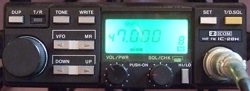 VHF FM 2 Meter Mobile Ham Radio Transceiver
We can operate mobile from a car, a boat, a private plane, a recreational vehicle, a motor bike, even from a bicycle and on foot!
Most mobile ham radio activity takes place on the VHF and UHF bands because of:
- small radio antennas,
- compact transceivers,
- repeater availability.
Operating mobile on HF is becoming popular again...
- not only because of the very compact HF transceivers and more efficient mobile HF antennas,
- but also because of sunspot cycle 24 providing improved communication opportunities.
Keep your mobile operating safe and legal ... and have fun!
Used Ham Radio Transceiver
Buying Tips
You can buy a used ham radio from many sources. I recommend that you look for what you want from the following sources, in that order.
- A reputable merchant.
- A ham radio operator you know.
- A ham radio operator you do not know.
Each one has its own advantages and drawbacks. To help you weigh them carefully, here is some info.
Never buy an amateur radio transceiver, transmitter or power amplifier (new or used) from someone who is not a licensed amateur radio operator in good standing, or an authorized dealer!
In fact, be especially wary if they do not ask for proof that you are a licensed ham in good standing yourself!
The above warning does not apply when you are buying a receiver, of course. (For the benefit of those who are aspiring ham radio operators, one does not need a license to own and operate a receiver ;)
Used Ham Radio Transceivers
From A Retailer
Reputable retailers of ham radio equipment sometimes take radios as trade-ins, and offer them for sale.
You will pay a little more, of course, but here is why.
- They inspect and test the radio before they offer it for sale. Make sure they officially declare that they do!
- They will sell it to you with the original user manual (or a copy of it). There
is nothing more frustrating than to realize, some months after the
sale, that the manual is not the one that corresponds to the exact model of radio you bought. In such a case, some of the tuning and maintenance procedures may likely not be applicable to your unit!
- They will normally offer a guarantee and will perhaps have an established return policy. Make sure you understand and accept the terms before you buy.
Buying From
A Ham You Know
If you do not know an amateur radio operator that has the used ham radio you want for sale, then the best place for real bargains is your local amateur radio club.
If one of the club members has the transceiver (or transmitter or power amplifier) you want for sale, arrange to test it.
Note: use a dummy load to test the transmitter!
The best testing procedure for ham radio transceivers - and the only one I recommend - is to use the manual and run through the test procedure recommended by the manufacturer. This way, you will...
- ensure that the unit works on all bands,
- and that you have the right manual!;-)
One quick way is to do a Google search for the exact make & model you are planning to buy.
Prices will range widely (wildly!) depending on the condition of the units and the seller, his/her knowledge of the market, honesty or greed!
For this reason, the best references are recognized retailers.
Buying From A Ham
Unknown To You
If you are planning to buy a used ham radio transceiver from a licensed amateur radio operator you do not know, then you will have to take extra precautions to avoid being taken in.
This may sound harsh, but a ham license is not necessarily a guarantee of honesty. Humans ... are humans, after all.
73 de VE2DPE
Claude Jollet
7, Rue de la Rive, Notre-Dame-des-Prairies, Québec, Canada J6E 1M9
QTH Locator: FN36gb
Recent Articles


-
Ham Radio - Amateur Radio Fascinating Secrets
Apr 21, 24 11:06 AM
 Ham radio or amateur radio has fascinated generations. This Web site reveals the secrets behind its enduring popularity and usefulness.
 -
World Amateur Radio Day (WARD)
Apr 17, 24 08:00 PM
April 18, 2024 is World Amateur Radio Day (WARD). Let's all get on the air and make contacts to celebrate this event in style! -
The Ham Radio Infopreneur In You
Apr 01, 24 11:17 AM
Believe it or not, there is an infopreneur (online entrepreneur) in many of us! Often, all you need to make it bloom is proper guidance. You can get it here.


Disclosure
If
you make a purchase via a link on this site, I may receive a small
commission on the transaction, at no extra cost to you. Thank you!
Disclosure
If
you make a purchase via a link on this site, I may receive a small
commission on the transaction, at no extra cost to you. Thank you!
(One word queries work best)
EQUIPMENT
Section
Contents
FOUND THIS
SITE
USEFUL?
VE2DPE
Is a member
in good standing
of





%20operator%20VE2DPE%20owner%20of%20www.HamRadioSecrets.com)
Also a proud member of an international community of solopreneurs
using SoloBuildIt!
(SBI!)
to promote my self-published eBooks
since 2005.
See my review
of this unique product for online businesses.
CQ CQ CQ
If you have a question, a comment or a topic you would like me to cover, please do not hesitate to ask here.
Have You Found This Web Site Useful?
Please contribute [ $0.99 ] - [ $3.99 ] - [ $4.99 ] - [ $5.99 ] by way of thanks.
Thank you for your contribution.
You will receive a valuable e-book in return for your generosity.
Solo Build It!
"I'm a solopreneur by design, supported by kindred minds within SBI!"Site Design & Content By Claude Jollet - VE2DPE
Certain text links and image ads on this website contain affiliate links.
I will receive a small commission - at no extra cost to you - if you make a purchase after clicking on them.
For example, as a SiteSell inc. affiliate, I earn from qualifying purchases.

Copyright© 2008-2024 Claude Jollet - HamRadioSecrets.com | All Rights Reserved