Amateur Radio Antenna
For 160 Meters
My homemade amateur radio antenna for the 160 meter band is the result of many considerations, inner debates and tests.
The ARRL Antenna Handbook (16th ed. June 1991) helped me understand what essential considerations I had to take into account.
Nevertheless, the love of experimenting with antennas played a critical part in the successful outcome of this homemade antenna project.
The Compromises
Every antenna is a set of compromises. This one is no exception.
I had to take into account...
- available horizontal space
- available supports (tower and trees)
- a quarter wave vertical is out of the question, at just under 40 meters in height (130 feet)!
Granted, I could have considered a top "loaded" vertical, with a top coil (inductance) to make up for short physical height.
But, I do not like verticals, "loaded" or not! They may be good enough for transmitting energy (+/-) but they are poor receiving antennas, being so short relative to the wavelength of interest.
Furthermore, quarter wave verticals just "bleed" too much precious RF energy in the ground system for my taste.
So I had to choose some form of "roughly balanced" horizontally deployed antenna.
Choosing The Lesser
Of Many Evils!
After playing with all kinds of weird configurations, I finally settled on a dipole for its inherently balanced and higher efficiency in capturing and radiating energy.
But, I had to fit (squeeze) the 160M dipole inside the boundaries of my lot!
So, I bent the rules ... and the antenna, somewhat! ;-)
The result is a "hybrid" dipole or "ungrounded" vertical amateur radio antenna, depending on your point of view!
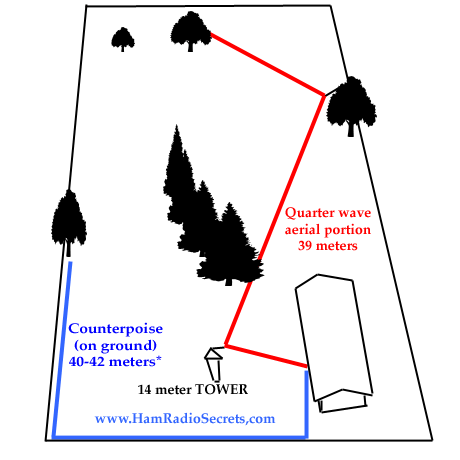
- The feed point is just outside my basement shack window, about one meter (3 feet) above ground.
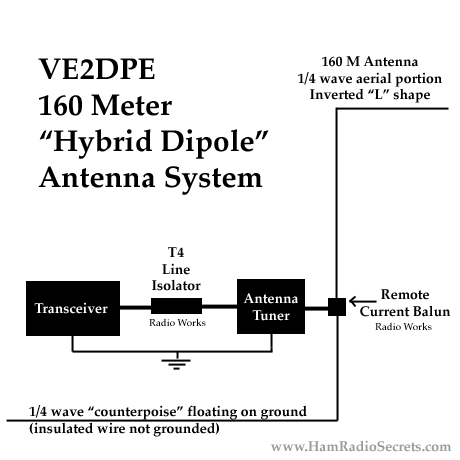
- I feed the antenna with a short length (less than 16 feet) of RG-8X through a RemoteBalun® (current balun) made by Radio Works. The balun prevents RF energy from leaking back into the shack via the coax shield.
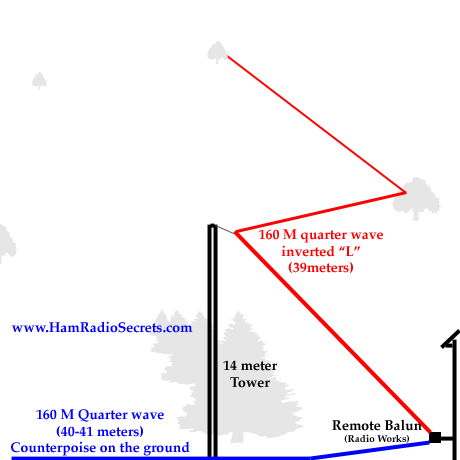
- One side of the dipole goes up from near
ground level to about 14 meters (45 feet), then out (25 meters) toward
the front of my lot. This portion becomes an inverted "L" ungrounded quarter wave vertical, 39 meters in length, made up of #14 stranded (7x22) copper-clad antenna wire.
- The other side of the dipole is a quarter wave "floating" counterpoise for the inverted "L" vertical portion. It lies on the ground and is insulated from it (#14 insulated multi strand wire). It is (roughly) deployed in the opposite direction from the inverted "L". I recommend that you seal the end carefully.
WARNING!
I have never fed this antenna with more than 100 watts. In fact, I usually work QRP. However, because the counterpoise lies on the ground, and is not buried, I would not be comfortable using this antenna with higher power. There might be high RF voltage present at the tip of the counterpoise which might be harmful to humans or animals if they come in contact with the counterpoise part of the antenna system.
Amateur Radio Antenna
Schematic Views
Schematic View
Overhead View
View From Back Of House
If you have trouble getting your antenna tuner to deal with the reactance of this antenna, you can try...
- cutting back on the length of the counterpoise,
- or simply folding it back on itself and tightly tape,
about ten (10) centimeters at a time.
The Results
Are What Counts
As you can see, this amateur radio antenna system for 160 meters is "unorthodox", to say the least. It is the best set of compromises I have been able to come up with, after many experiments.
Oh! By the way. It works like a charm, for both local and DX!
"The antenna keeps producing impressive contacts, is easily erected and
taken down, and combines simplicity with remarkable performance. It is
definitely a keeper for me. Best wishes and 73".
Chris,
K5LH
(More by K5LH on this 160m antenna ...)
73 de VE2DPE
Claude Jollet
104-30 avenue des Berges,
Notre-Dame-des-Prairies, Québec, Canada J6E 1M9
QTH Locator: FN36gb
Recent Articles


-
Ham Radio Books - HF Wire Antennas
Jan 01, 26 05:01 PM
 HF wire antennas are not hard to understand when explained in simple terms as they are in these ham radio books and e-Books.
 -
Ham Radio - Amateur Radio Fascinating Secrets
Jan 01, 26 03:33 PM
 Ham radio or amateur radio has fascinated generations. This Web site reveals the secrets behind its enduring popularity and usefulness.
 -
Ham Radio Kits - An Introduction With List Of Manufacturers
Sep 27, 25 02:42 PM
Ham radio kits pack a lot of value. This page explains how much and why.
Disclosure
If
you make a purchase via a link on this site, I may receive a small
commission on the transaction, at no extra cost to you. Thank you!
Disclosure
If
you make a purchase via a link on this site, I may receive a small
commission on the transaction, at no extra cost to you. Thank you!
(One word queries work best)
HF Antennas
Section
Contents
VHF/UHF Antennas
FOUND THIS
SITE
USEFUL?
VE2DPE
Is a member
in good standing
of


%20antenna.)
%20operator%20VE2DPE%20owner%20of%20www.HamRadioSecrets.com)
Also a proud member of an international community of solopreneurs
using SoloBuildIt!
(SBI!)
to promote my self-published eBooks
since 2005.
See my review
of this unique product for online businesses.
CQ CQ CQ
If you have a question, a comment or a topic you would like me to cover, please do not hesitate to ask here.
Have You Found This Web Site Useful?
Please contribute [ $0.99 ] - [ $3.99 ] - [ $4.99 ] - [ $5.99 ] by way of thanks.
Thank you for your contribution.
You will receive a valuable e-book in return for your generosity.
Solo Build It!
"I'm a solopreneur by design, supported by kindred minds within SBI!"Site Design & Content By Claude Jollet - VE2DPE
Certain text links and image ads on this website contain affiliate links.
I will receive a small commission - at no extra cost to you - if you make a purchase after clicking on them.
For example, as a SiteSell inc. affiliate, I earn from qualifying purchases.

The content of HamRadioSecrets.com website
is NOT generated with the help of artificial intelligence.
Scraping the contents of HamRadioSecrets.com website
for the purpose of AI (artificial intelligence) LLM (Large Language Model) training
is strictly forbidden.
Copyright© 2008-2026 Claude Jollet - HamRadioSecrets.com | All Rights Reserved